1. What is Science?
Science is a systematic way of understanding the natural world around us.
Science is based on:
- Observation
- Curiosity
- Logical thinking
- Evidence
Science is not just a collection of facts, but a process of exploration and discovery.
Key Point
Science helps us understand how things happen and improves our daily life.
1. Science as a Way of Understanding the World
Science helps us understand the “how” and “why” of natural phenomena.
It:
- Explains events using natural causes.
- Helps us make sense of the world in a rational and logical way.
- Is based on evidence, not on beliefs or assumptions.
Examples of Scientific Understanding
Why does it rain?
Rain occurs due to processes in the water cycle such as evaporation, condensation and precipitation.
Why do objects fall?
Objects fall towards Earth due to gravity.
Why do we see in the dark?
We see objects when light reaches our eyes, either directly or after reflection from objects.
Why do plants grow?
Plants need suitable conditions such as water, air, sunlight and nutrients for growth.
2. Scientific Thinking
Scientific thinking means thinking logically, curiously and rationally to understand the world.
It involves:
- Asking questions
- Looking for evidence
- Analysing information
- Being open to new ideas
- Avoiding assumptions and biases
- Drawing conclusions based on facts
Characteristics of Scientific Thinking
Curiosity
Eagerness to know more and explore.
Open-mindedness
Being ready to accept new ideas when supported by evidence.
Objectivity
Avoiding personal bias while analysing information.
Critical Thinking
Carefully analysing information before accepting a conclusion.
Creativity
Thinking of new ideas and possible solutions.
3. Observation and Curiosity
Observation means carefully seeing, hearing or measuring to gather information.
Observation may be made using our senses or scientific instruments.
Curiosity is the desire to know more and explore the unknown.
Good observation is the first step in scientific investigation.
Examples of Observation
- Observing the shape and colour of leaves.
- Observing changes in the sky.
- Observing how a plant grows over time.
4. Asking Questions
A scientist always asks questions about natural phenomena.
Questions help us:
- Identify problems.
- Find answers.
- Explore natural phenomena.
Good scientific questions are based on observation and curiosity.
Types of Questions
1. Descriptive Question
Asks:
“What is happening?”
2. Comparative Question
Asks:
“How is it different?”
3. Causal Question
Asks:
“Why is it happening?”
4. Predictive Question
Asks:
“What will happen if…?”
Examples of Scientific Questions
- Why does this happen?
- How does it happen?
- What happens when conditions change?
- When does it happen?
- Where does it happen?
- What will happen if a particular factor is changed?
5. Evidence in Science
Science is based on evidence, not on personal beliefs or opinions.
Definition of Scientific Evidence
Scientific evidence is information collected through observation, experiments, measurement and analysis that can be used to support a scientific conclusion.
Evidence can be collected through:
- Observation
- Experiments
- Measurement
- Data analysis
Example: Melting of Ice
When ice is heated, it melts and becomes water.
This conclusion is based on observation and experimental evidence.
Key Point: Scientific conclusions should be supported by evidence.
6. Scientific Method
Definition
The scientific method is a step-by-step process used to solve problems and find answers to scientific questions.
It is used in scientific investigations to make reliable and valid conclusions.
Steps of the Scientific Method
- Observation
- Notice or identify a problem.
- Ask a Question
- Identify what you want to find out.
- Form a Hypothesis
- Give a possible explanation.
- Plan and Conduct an Experiment
- Test the hypothesis systematically.
- Analyse the Data
- Examine the information collected.
- Draw a Conclusion
- Decide what the evidence shows.
Key Point
The scientific method helps us find answers based on evidence.
7. Experiments in Science
Definition
An experiment is a planned activity carried out under controlled conditions to test a hypothesis.
Experiments help us understand cause-and-effect relationships.
In an experiment, scientists may change one factor at a time while keeping other relevant conditions the same.
Example: Growth of a Plant
Consider four plants:
Plant A
With water and sunlight:
- Grows well.
Plant B
Without water:
- Does not grow properly.
Plant C
Without sunlight:
- Grows slowly.
Plant D
Without water and sunlight:
- Dies.
Important Points
- Keep other conditions the same where possible.
- Change one factor at a time.
- Record and compare the results.
8. Models in Science
Definition
A model is a simplified representation of a real object, system or process.
Models help us understand complex ideas easily.
Models can be:
- Physical models
- Conceptual models
- Mathematical models
Physical Model
A physical model is a real object or replica that represents something.
Example:
A globe is a model of Earth.
Conceptual Model
A conceptual model is a diagram or idea that helps explain a concept.
Example:
A diagram showing evaporation, condensation and precipitation can represent the water cycle.
Mathematical Model
A mathematical model uses numbers, equations or mathematical relationships to represent a situation.
Example:
Distance:
d = v × t
where:
d = distance
v = speed
t = time
9. Using Models to Understand Phenomena
Models help us visualise and explain things that are very small, very large or difficult to observe directly.
They are useful for:
- Understanding complex systems.
- Explaining scientific ideas.
- Making predictions.
- Communicating ideas.
Examples
Model of an Atom
Used to represent the structure of an atom.
Model of the Solar System
Used to represent the Sun, planets and their arrangement.
Model of the Human Body
Used to represent the major structures and organs of the human body.
Key Point
A model is a simplified representation and may not show every detail of the real system.
10. Science and Mathematics
Definition
Mathematics is a powerful tool in science.
It helps scientists to:
- Measure quantities.
- Calculate values.
- Analyse data.
- Make predictions.
Many scientific concepts are expressed using mathematical equations.
Examples
Speed of an Object
v = d/t
where:
v = speed
d = distance
t = time
Area of a Rectangle
A = l × b
where:
A = area
l = length
b = breadth
Volume of a Cube
V = a³
where:
V = volume
a = length of an edge of the cube
Key Point
Mathematics helps make scientific relationships precise and measurable.
11. Precise Language in Science
Science uses precise and clear language to avoid confusion.
Scientific words have specific meanings.
Important scientific terms should be defined carefully and used consistently.
Why is Precise Language Important?
It helps in:
- Accurate communication.
- Clear understanding.
- Avoiding confusion.
- Sharing scientific ideas effectively.
Examples of Everyday and Scientific Meanings
Work
Everyday meaning:
Any physical or mental effort.
Scientific meaning:
Work is associated with the product of force and displacement in the direction of the force.
W = F × s
Theory
Everyday meaning:
A guess or idea.
Scientific meaning:
A well-tested explanation based on evidence.
Model
Everyday meaning:
A small copy or representation.
Scientific meaning:
A simplified representation used to explain a real system.
12. Data and Measurements
Definition of Data
Data is the information collected during an observation or experiment.
Data can be:
- Qualitative
- Quantitative
Qualitative Data
Qualitative data is descriptive or non-numerical information.
Examples:
- Colour of an object.
- Smell of a substance.
- Texture of a leaf.
Quantitative Data
Quantitative data is numerical information.
Examples:
- Height of a plant.
- Temperature.
- Mass.
- Length.
Key Point
Measurements are used to obtain quantitative data.
13. Units of Measurement
To measure a physical quantity, we compare it with a standard unit.
The International System of Units (SI) is used around the world.
SI Base Units
| Physical Quantity | Symbol | SI Unit | Unit Symbol |
|---|---|---|---|
| Length | l | metre | m |
| Mass | m | kilogram | kg |
| Time | t | second | s |
| Temperature | T | kelvin | K |
| Electric current | I | ampere | A |
| Amount of substance | n | mole | mol |
| Luminous intensity | Iᵥ | candela | cd |
Why are Standard Units Important?
Using the same units worldwide allows scientists to:
- Communicate measurements.
- Compare results.
- Share scientific information.
- Obtain consistent results.
Example
Length of a pencil = 5.2 cm
Here:
5.2 = numerical value
cm = unit
14. Estimation and Approximation
Definition of Estimation
Estimation means finding a close or approximate value without making an exact measurement or calculation.
Estimation is useful in daily life.
Definition of Approximation
Approximation means using a rounded or simplified value to make calculations easier.
Exact values are not always necessary.
Importance of Estimation
Estimation helps in:
- Quick decision-making.
- Checking whether an answer is reasonable.
- Making calculations simpler.
- Understanding approximate quantities.
Examples
- Number of students in a classroom ≈ 30
- Length of a book ≈ 20 cm
- Time to reach school ≈ 15 minutes
- Distance from home to school ≈ 2 km
- Population of a city ≈ 10 lakh (1,000,000)
Key Point
Estimation gives a quick idea about the approximate value of a quantity.
15. Measuring Tools and Their Use
Different physical quantities are measured using different instruments.
| Instrument | Quantity Measured |
|---|---|
| Ruler / Measuring Tape | Length |
| Balance (Beam or Digital) | Mass |
| Stopwatch | Time |
| Thermometer | Temperature |
| Measuring Cylinder | Volume of liquid |
Important Point
The instrument chosen for measurement should be suitable for the physical quantity being measured.
16. Accuracy, Precision and Error
Accuracy
Accuracy refers to how close a measurement is to the true or accepted value.
Precision
Precision refers to how close repeated measurements are to each other.
Error
Error is the difference between a measured value and the true or accepted value.
Measurements may not always be perfect.
Errors may occur due to:
- Instrument limitations.
- Observer-related mistakes.
- Environmental conditions.
- Other sources of uncertainty.
Accuracy and Precision
High Accuracy + High Precision:
Measurements are close to the true value and close to each other.
High Accuracy + Low Precision:
Measurements are close to the true value but not close to each other.
Low Accuracy + High Precision:
Measurements are close to each other but not close to the true value.
Low Accuracy + Low Precision:
Measurements are neither close to the true value nor close to each other.
17. Recording and Organising Data
Data can be recorded in the form of:
- Tables
- Charts
- Graphs
- Diagrams
Organising data helps in easy analysis and comparison.
Graphs provide a clear visual representation of data.
Example: Plant Growth
| Day | Height of Plant (cm) |
|---|---|
| 0 | 0 |
| 5 | 2 |
| 10 | 5 |
| 15 | 8 |
| 20 | 12 |
The data can be represented using a graph of:
Day vs Height of Plant.
Key Point
Tables organise data, while graphs help us see patterns and trends more easily.
18. Laws, Theories and Principles
Scientific Law
A scientific law is a statement that describes a natural phenomenon or a consistent relationship observed under given conditions.
It describes what happens in nature.
Example:
Law of gravitation.
Objects fall towards Earth due to gravitational interaction.
Scientific Theory
A scientific theory is a well-tested explanation that accounts for a wide range of observations and evidence.
A theory explains how or why something happens.
Examples:
- Atomic theory
- Theory of evolution
Scientific Principle
A principle is a general idea or rule that helps us understand a phenomenon.
Example:
Conservation of energy.
Difference
| Law | Theory | Principle |
|---|---|---|
| Describes what happens | Explains how or why it happens | A broad and general rule or idea |
| Based on observations | Based on evidence and observations | Helps understand and solve problems |
| Example: Law of gravitation | Example: Atomic theory | Example: Conservation of energy |
19. Scientific Predictions
Definition
A scientific prediction is an evidence-based statement about what is expected to happen under particular conditions.
Predictions can be based on:
- Observations
- Patterns
- Mathematical models
- Scientific laws
- Scientific theories
Examples
Solar Eclipse Prediction
Scientists can predict when a solar eclipse will occur by using knowledge of the motions of the Earth, Moon and Sun.
Weather Forecasting
Scientific data and models can be used to predict rain, temperature and storms.
Motion of Planets
The future positions of planets can be predicted using laws of motion and gravity.
20. Importance of Predictions
Scientific predictions are useful for:
- Planning and decision-making.
- Agriculture.
- Disaster management.
- Transportation.
- Space exploration.
- Preparing for future events.
Examples
Agriculture
Weather predictions help farmers plan agricultural activities.
Disaster Management
Early predictions of cyclones, floods and earthquakes can help reduce risks and save lives.
Space Exploration
Predictions help scientists plan spacecraft launches and navigation.
21. Experimental Science
Science is based on experiments and observations.
Experiments are carried out under controlled conditions.
Variables are changed one at a time where possible to study their effects.
Experiments help in:
- Testing hypotheses.
- Understanding cause and effect.
- Supporting or challenging explanations.
Example: Effect of Light on Plant Growth
Plant with no light:
- Does not grow properly.
Plant with less light:
- Grows slowly.
Plant with more suitable light:
- Grows well.
Important Points
- Keep other relevant conditions the same.
- Change one factor at a time.
- Record the results.
- Compare the results.
22. Science and Society
Science has a deep impact on society.
It helps in:
- Improving living conditions.
- Improving quality of life.
- Influencing culture and economy.
- Changing the way people think.
- Developing new technologies.
- Creating better opportunities.
Examples of the Impact of Science
Healthcare
Vaccines and medicines help prevent and treat diseases.
Communication
Mobile phones and the internet connect people around the world.
Transportation
Scientific innovations make travel faster and safer.
Agriculture
Better seeds, fertilisers and irrigation methods can increase food production.
23. Science, Technology and Innovation
Scientific knowledge leads to technology.
Definition of Technology
Technology is the practical application of scientific knowledge and ideas to create useful tools, systems, products or methods.
Definition of Innovation
Innovation means creating or developing new ideas, products, tools, methods or solutions.
Relationship
Scientific Idea
↓
Research and Development
↓
Technology
↓
Innovation and New Products
Examples
Solar Panels
Scientific knowledge of light and energy is used to generate electricity.
Water Purification Technology
Scientific knowledge is used to provide clean and safe drinking water.
Modern Medicines
Scientific research helps develop medicines to fight diseases.
Space Technology
Science and technology help in communication, weather forecasting and exploring space.
24. Responsible Use of Science
Science is a powerful tool, but it can also be misused.
We must use scientific knowledge responsibly and ethically.
It is important to consider the:
- Social consequences
- Environmental consequences
- Ethical consequences
of scientific advancements.
Positive Uses
- Cleaner energy sources such as solar and wind energy.
- Development of vaccines and medicines.
- Sustainable agriculture.
- Waste management and recycling.
- Disaster prediction and management.
Misuse and Risks
- Nuclear weapons.
- Environmental pollution.
- Harmful chemicals and substances.
- Misuse of personal data and privacy issues.
- Overuse of natural resources.
Key Point
Scientific knowledge should be used for the benefit of people and the environment.
25. Science for a Sustainable Future
Definition of Sustainable Development
Sustainable development means meeting the needs of the present without compromising the ability of future generations to meet their needs.
Science helps us find solutions for a cleaner, greener and healthier planet.
Science supports:
- Conservation of natural resources.
- Clean and renewable energy.
- Sustainable agriculture.
- Waste reduction.
- Environmental protection.
- Biodiversity conservation.
Key Areas for a Sustainable Future
- Renewable energy sources
- Conservation of water
- Waste reduction and recycling
- Protection of forests and biodiversity
- Control of pollution
- Sustainable agriculture
- Responsible use of resources
- Green technologies and innovation
Our Responsibility
We should:
- Use scientific knowledge wisely.
- Protect the environment.
- Conserve natural resources.
- Support clean and renewable energy.
- Reduce waste and pollution.
- Make informed and responsible decisions.
- Work towards a healthier and sustainable planet.
26. Careers in Science
Science offers a wide range of career opportunities.
Scientific knowledge can help us solve real-world problems and contribute to society.
Some Career Options
| Career | Work Area |
|---|---|
| Scientist | Research in physics, chemistry, biology, etc. |
| Engineer | Design and develop new technologies |
| Doctor | Healthcare and medical research |
| Environmentalist | Protect and conserve the environment |
| Data Scientist | Analyse data and solve complex problems |
| Space Scientist | Explore planets, stars and the universe |
27. Science Around Us
Science is a part of our daily life.
We use scientific knowledge in many ways, often without realising it.
Science helps us solve problems and make life:
- Easier
- Safer
- Healthier
- Better
Examples in Daily Life
Pressure Cooker
Helps cook food faster.
Mobile Phone
Used for communication.
LED Bulb
Uses electricity to produce light.
Water Purifier
Helps provide clean drinking water.
Refrigerator
Helps keep food fresh.
Medicines
Help improve health and treat diseases.
28. Benefits of Science
Science provides many benefits to society.
It:
- Helps in better healthcare and longer life.
- Increases food production.
- Provides clean and renewable sources of energy.
- Improves communication and transportation.
- Helps in environmental protection.
- Creates new job opportunities.
- Improves quality of life.
- Helps in exploring space and understanding the universe.
Examples
- Vaccines help prevent diseases.
- High-yield crops can increase food supply.
- Solar and wind energy reduce dependence on polluting energy sources.
- Modern transport saves time.
- Environmental monitoring helps protect nature.
29. Challenges in Science
Science and technology can also create challenges when knowledge is misused or poorly managed.
Major Challenges
1. Misuse of Scientific Knowledge
Examples include weapons and harmful chemicals.
2. Environmental Pollution
Industrial and chemical activities can contribute to pollution.
3. Overuse of Natural Resources
Examples include deforestation and excessive mining.
4. Ethical Issues
New developments in biotechnology and artificial intelligence can raise ethical questions.
5. Need for Responsible Use
Scientific knowledge must be used responsibly for a sustainable future.
30. Science, Technology and Society
Scientific knowledge leads to technology.
Technology helps solve human problems and can improve the quality of life.
However, science and technology can also create challenges such as:
- Environmental pollution.
- Misuse of resources.
- Ethical issues.
Science → Technology → Society
Science:
Knowledge and discovery of facts and natural laws.
↓
Technology:
Practical application of scientific knowledge to create tools and solutions.
↓
Society:
Improved health, communication, transportation and living conditions.
31. Science for a Sustainable Future
Definition
Sustainable development means meeting present needs without compromising the ability of future generations to meet their needs.
Science can help create:
- Cleaner energy.
- Better environmental protection.
- Sustainable agriculture.
- Efficient use of resources.
- Better waste management.
Steps Towards a Sustainable Future
- Reduce, Reuse and Recycle.
- Conserve natural resources.
- Use renewable energy.
- Protect biodiversity.
- Reduce pollution.
- Use resources responsibly.
32. Quick Revision: Key Ideas from Chapter 1
- Science helps us understand the world through observation, experiments and reasoning.
- The scientific method involves asking questions, collecting evidence, testing ideas and drawing conclusions.
- Models, measurements, mathematics and precise language are important in science.
- Scientific knowledge helps us make predictions and solve real-world problems.
- Science has many branches such as Physics, Chemistry, Biology, Earth Science and Space Science.
- Science and technology improve our quality of life but must be used responsibly.
- We must work towards a sustainable future for ourselves and future generations.
MIND MAP: ENTERING THE WORLD OF SECONDARY SCIENCE
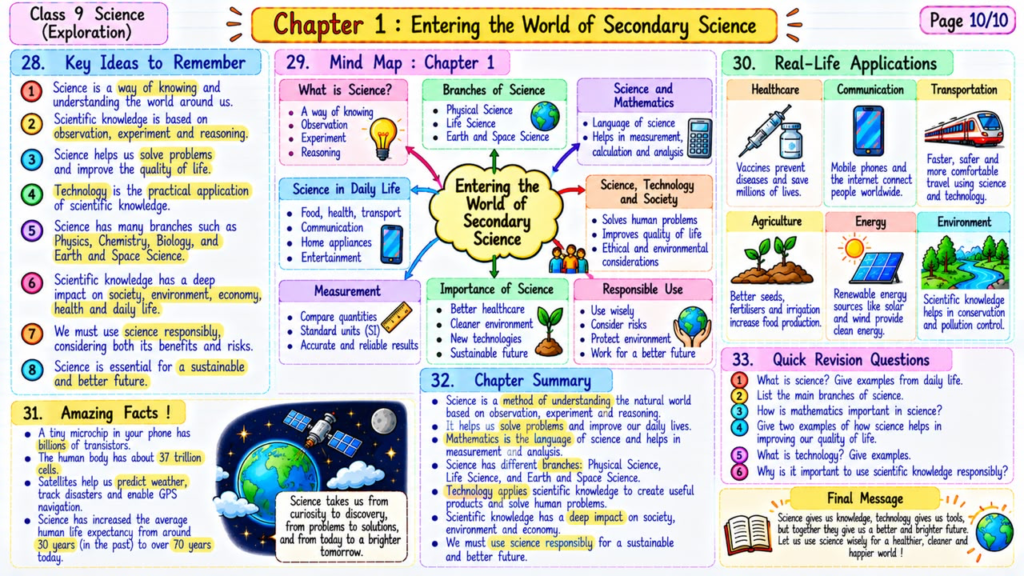
KEY DEFINITIONS FOR QUICK REVISION
- Science: A systematic way of understanding the natural world using observation, evidence, reasoning and investigation.
- Scientific Thinking: Thinking logically, rationally and critically using evidence to understand the world.
- Observation: Carefully seeing, hearing or measuring something to gather information.
- Curiosity: The desire to know more and explore the unknown.
- Scientific Investigation: A planned and systematic process used to answer a scientific question or solve a problem.
- Scientific Method: A step-by-step approach involving observation, questioning, hypothesis, experiment, data analysis and conclusion.
- Hypothesis: A possible explanation or tentative answer that can be tested scientifically.
- Experiment: A planned investigation carried out under controlled conditions to test a hypothesis or scientific question.
- Model: A simplified representation of a real object, system or process.
- Data: Information collected during an observation or experiment.
- Qualitative Data: Descriptive, non-numerical information.
- Quantitative Data: Numerical information obtained through counting or measurement.
- Measurement: The process of comparing a physical quantity with a standard unit.
- SI System: The International System of Units used as a standard system of measurement.
- Estimation: Finding a close or approximate value without determining an exact value.
- Approximation: Using a rounded or simplified value.
- Accuracy: How close a measurement is to the true or accepted value.
- Precision: How close repeated measurements are to each other.
- Error: The difference between a measured value and the true or accepted value.
- Scientific Law: A statement describing a consistent pattern or relationship observed in nature under specified conditions.
- Scientific Theory: A well-tested, evidence-based explanation of natural phenomena.
- Scientific Principle: A general idea or rule that helps us understand a scientific phenomenon.
- Scientific Prediction: A testable statement about what is expected to happen under specified conditions.
- Technology: The practical application of scientific knowledge to create useful tools, products, systems or solutions.
- Innovation: The creation or development of new ideas, products, tools, methods or solutions.
- Sustainable Development: Meeting the needs of the present without compromising the ability of future generations to meet their needs.
FINAL CHAPTER SUMMARY
Science is a systematic way of understanding the natural world. It is based on observation, curiosity, evidence, logical thinking and experimentation.
Scientific thinking involves asking questions, looking for evidence, analysing information, avoiding bias and drawing conclusions based on facts.
The scientific method provides a systematic way to investigate problems. It involves observation, questioning, forming a hypothesis, conducting an experiment, analysing data and drawing conclusions.
Scientists use models to simplify complex objects, systems and processes. Mathematics helps scientists measure quantities, analyse data and express scientific relationships using equations.
Measurements require standard units. The SI system provides an internationally accepted system of measurement. Accuracy, precision and error are important concepts when taking measurements.
Scientific knowledge includes laws, theories and principles. Scientific laws describe consistent patterns, theories provide evidence-based explanations, and principles express broad scientific ideas.
Science has many branches, including Physical Science, Life Science, and Earth and Space Science. Physics and Chemistry are important areas of Physical Science, while Biology is a major area of Life Science.
Science is closely connected with technology and innovation. Scientific knowledge has contributed to developments in healthcare, communication, transportation, agriculture, energy and space exploration.
Science also affects society. It can improve quality of life, but scientific knowledge and technology must be used responsibly because misuse can cause environmental, social and ethical problems.
Science can help us build a sustainable future through renewable energy, conservation of resources, pollution control, sustainable agriculture, recycling and protection of biodiversity.
The central message of this chapter is:
Science helps us understand the world, solve problems and improve life. Scientific knowledge should be used responsibly to create a healthier, safer and more sustainable future.